
The Real Ergonomic Equation: Why Less Sitting Isn't the Whole Answer
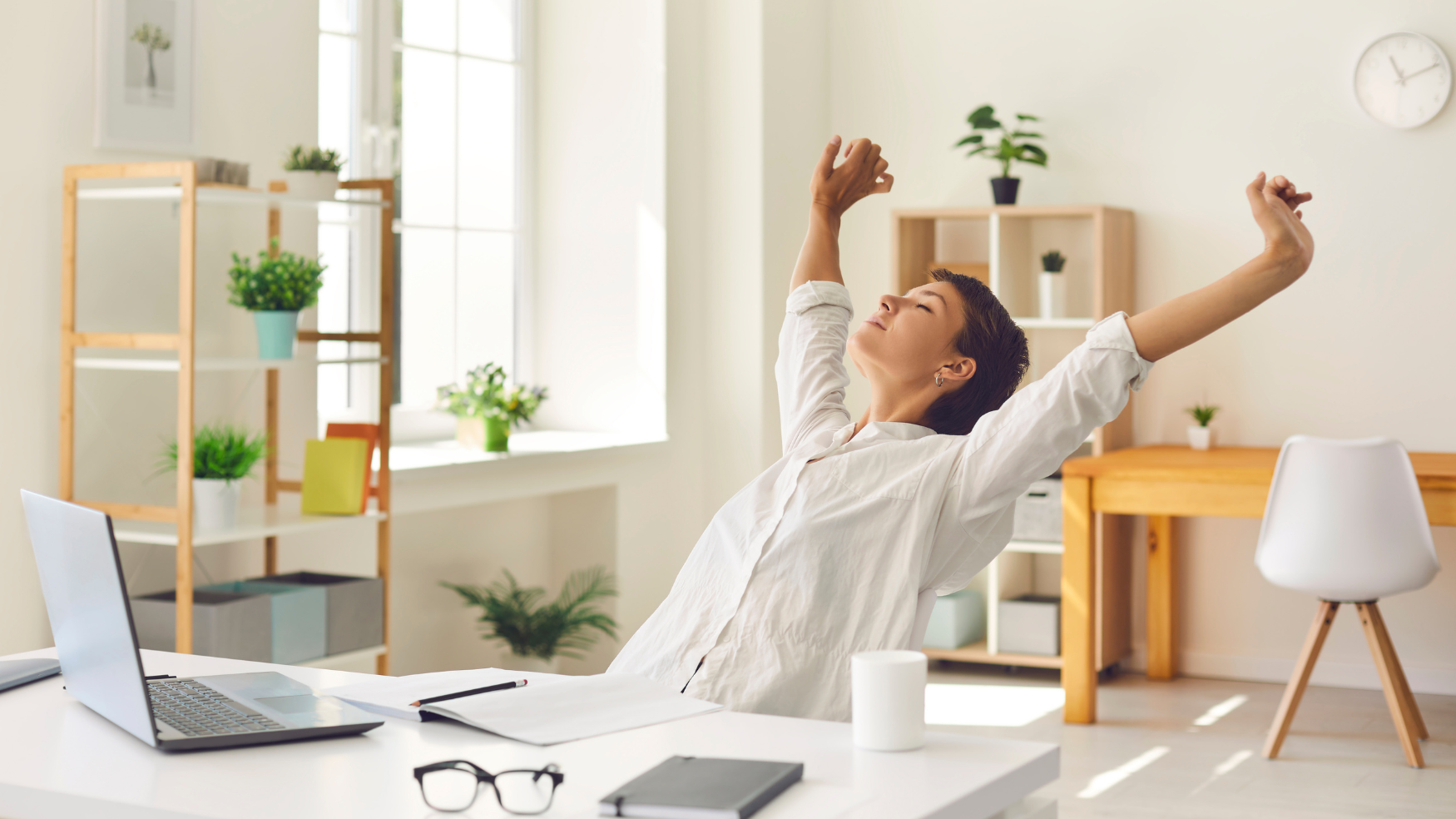
Is Your Desk Job Hurting Your Back? It Might Be Your Habits, Not Your Desk.
Most of us spend the majority of our days at a desk, often neglecting our posture and setup until the pain in our neck, shoulders, or lower back finally forces us to pay attention.
At Aware Health, we see the impact of this daily. Global studies consistently highlight low back pain as a primary driver of work loss and disability, affecting productivity and overall quality of life. The good news? Relief is closer than you think - no radical office renovations or career pivots required.
The key isn’t simply “standing more” or “sitting less.” It’s about fine-tuning your environment to better support your body's needs.
The Ergonomic Equation: Think "Motion," Not Just "Posture"
A common misconception is that sitting is inherently "bad" and standing is "good." The real issue isn’t the position itself, but the lack of movement while you're in it.
How can ergonomics help? Ergonomics is about getting your environment to work with you, not against you. To reduce strain, focus on this simple formula:
Less total sitting + more movement + a neutral and supportive setup = less pain.
You can control your physical well-being more than you might think. Here are three easy and practical ways to start today:
1. Optimize Your Setup (Neutral Posture)
- For Sitting: Keep your hips at 90 degrees with your feet supported. Ensure your lumbar spine is supported and your monitor is at arm's length, with the top of the screen at eye level. Elbows at 90 degrees and wrists relaxed.
- For Standing: Position your desk height so your elbows stay at 90 degrees, shoulders relaxed, and wrists in a neutral position.
- If your current setup doesn't match these guidelines, don't worry. You can achieve better alignment using common household items or affordable ergonomic tools. Here are some quick fixes:
|
Issue |
DIY Solutions |
Purchasable Upgrades |
|
Laptop or monitor position |
Books as risers |
External keyboard and mouse, laptop and monitor risers |
|
Feet not on the ground |
Home stool, books |
Desk stool, Chair with changeable height |
|
Low back not supported |
Rolled up towel, sweatshirt |
Lumbar support chair, lumbar support roll |
|
Elbows not at 90deg |
Pillow under forearms to support elbows into 90deg |
External keyboard and mouse |
2. Stop the "Stillness Rut"
Try not to sit or stand for extended periods of time. Break up sedentary time every 30-45 minutes. Even a brief 2-minute movement break can disrupt the physiological strain that leads to discomfort.
- Consider shifting your workspace to break up the monotony. If you typically sit at a desk, try transitioning to a common area, a counter, a different office, or even the floor, while ensuring you minimize prolonged sitting or standing in these new spaces.
3. Move with Intent
Integrate movement into your routine naturally:
- Stand for calls: Make it a rule to pace while you talk.
- The "Hydration Trick": Stay hydrated; this will force you to get up to use the restroom more often which will increase movement.
- Utilize your environment: Keep your trash can or printer a little further away, forcing you to get up and walk throughout the day.
- Micro-breaks: Use an alarm to prompt 15-20 minutes of standing or walking after every hour of focus.
- Make Meetings Mobile: Whenever possible, swap virtual calls or desk-based meetings for walking or standing sessions to keep yourself moving.
Fix the Physiology, Fix the Problem
It is important to remember that most back and neck pain is rarely due to serious pathology; it is often the result of repetitive strain on our bodies during prolonged tasks. By adjusting your workstation and introducing intentional movement, you can reduce overuse injuries and speed up your body’s natural recovery.
Start with the small changes you can control today. Your body—and your productivity—will thank you for it.
Are you looking to help your team stay healthier and more productive? At Aware Health, we specialize in helping organizations integrate physical therapy and ergonomic wellness into the daily flow of work. Reach out if you’d like to learn more about our on-site programming.
- American College of Sports Medicine. Physical activity guidelines. ACSM website. Accessed July 10, 2026. https://acsm.org/education-resources/trending-topics-resources/physical-activity-guidelines/.
- Bull FC, Al-Ansari SS, Biddle S, et al. World Health Organization 2020 guidelines on physical activity and sedentary behaviour. Br J Sports Med. 2020;54(24):1451-1462. Accessed July 10, 2026. https://pmc.ncbi.nlm.nih.gov/articles/PMC7719906/.
- Centers for Disease Control and Prevention. Adult activity: an overview. CDC website. Updated April 17, 2025. Accessed July 10, 2026. https://www.cdc.gov/physical-activity-basics/guidelines/adults.html.
- Centre for Registration of European Ergonomists. What is ergonomics. CREE website. Accessed July 9, 2026. https://eurerg.eu/what-is-ergonomics/.
- Chartered Institute of Ergonomics and Human Factors. What is ergonomics? CIEHF website. Accessed July 9, 2026. https://ergonomics.org.uk/knowledge-hub/what-is-ergonomics.html.
- Chen SM, Liu MF, Cook J, Bass S, Lo SK. Sedentary lifestyle as a risk factor for low back pain: a systematic review. Int Arch Occup Environ Health. 2009;82(7):797-806. Accessed July 10, 2026. https://pubmed.ncbi.nlm.nih.gov/19301029/.
- Dai Y, Li X, Zhou N, et al. The association between sedentary behavior and low back pain in adults: a systematic review and meta-analysis of longitudinal studies. PeerJ. 2022;10:e13127. Accessed July 10, 2026. https://peerj.com/articles/13127/.
- Gupta N, Hallman DM, Mathiassen SE, et al. Temporal patterns of sitting at work are associated with neck-shoulder pain in blue-collar workers: a cross-sectional analysis of accelerometer data in the DPHACTO study. Int Arch Occup Environ Health. 2016;89(5):823-833. Accessed July 10, 2026. https://link.springer.com/article/10.1007/s00420-016-1123-9.
- Hallman DM, Mathiassen SE, Heiden M, Gupta N, Jørgensen MB, Holtermann A. Association between objectively measured sitting time and musculoskeletal symptoms among office workers. BMC Public Health. 2021. Accessed July 10, 2026. https://pmc.ncbi.nlm.nih.gov/articles/PMC8666269/.
- Himmelfarb Health Sciences Library. AMA citation style: websites. George Washington University website. Published July 22, 2010. Accessed July 7, 2026. https://guides.himmelfarb.gwu.edu/AMA/websites.
- International Ergonomics Association. What is ergonomics (HFE)? IEA website. Accessed July 9, 2026. https://iea.cc/about/what-is-ergonomics/.
- Lake Washington Institute of Technology Library. AMA 11th edition quick style guide. LWTech website. Accessed July 7, 2026. https://www.lwtech.edu/campus-services/library/citation-tools/ama-style-quick-guide.aspx.
- Lis AM, Black KM, Korn H, Nordin M. Association between sitting and occupational low back pain. Eur Spine J. 2007;16(2):283-298. Accessed July 10, 2026. https://pubmed.ncbi.nlm.nih.gov/11045756/.
- Nadeem I, Ijaz H, Khalid S, Arsh A. Association between sitting time and neck-shoulder pain among office workers: a cross-sectional study. Pak J Physiol. 2021;17(1). Accessed July 10, 2026. https://www.pjp.pps.org.pk/index.php/PJP/article/view/1197.
- National Institute for Occupational Safety and Health (NIOSH). About ergonomics and work-related musculoskeletal disorders. Centers for Disease Control and Prevention website. Updated May 8, 2024. Accessed July 9, 2026. https://www.cdc.gov/niosh/ergonomics/about/index.html.
- National Institute for Occupational Safety and Health (NIOSH). Ergonomics and work-related musculoskeletal disorders. Centers for Disease Control and Prevention website. Updated May 11, 2024. Accessed July 9, 2026. https://www.cdc.gov/niosh/ergonomics/index.html.
- National Institute for Occupational Safety and Health (NIOSH). Ergonomics in the workplace. CDC Stacks website. Published March 14, 2019. Accessed July 9, 2026. http://stacks.cdc.gov/view/cdc/213728.
- New York Medical College Health Sciences Library. AMA (11/e) style guide: quick formatting tips. NYMC website. Published March 18, 2020. Accessed July 7, 2026. https://guides.library.nymc.edu/AMA11/quickTips.
- Norris R. AMA style (11th ed): citing your sources: reference list. University of Southern California Libraries website. Published April 14, 2020. Accessed July 7, 2026. https://libguides.usc.edu/c.php?g=1029472&p=8076397.
- Parry S, Straker L, Gilson ND, Smith AJ. Associations of office workers' objectively assessed occupational sitting, standing and stepping time with musculoskeletal symptoms. Ergonomics. 2019;62(1):115-125. Accessed July 10, 2026. https://pubmed.ncbi.nlm.nih.gov/29630479/.
- Quinnipiac University Libraries. AMA citation (11th edition) help: websites. Quinnipiac University website. Updated January 9, 2012. Accessed July 7, 2026. https://libraryguides.quinnipiac.edu/c.php?g=1010301&p=7319124.
- SAGE Publications. AMA 11 reference style. SAGE Journals website. Accessed July 7, 2026. https://journals.sagepub.com/pb-assets/AMA%2011%20style_April%202020.pdf.
- Shariat A, Cleland JA, Danaee M, et al. Effects of stretching exercise training and ergonomic modifications on musculoskeletal discomforts of office workers: a randomized controlled trial. Braz J Phys Ther. 2018;22(2):144-153. Accessed July 10, 2026. https://pmc.ncbi.nlm.nih.gov/articles/PMC5618737/.
- Todorovic J, et al. Factors associated with reduced risk of musculoskeletal disorders among office workers: a cross-sectional study. BMC Public Health. 2022;22. Accessed July 10, 2026. https://pmc.ncbi.nlm.nih.gov/articles/PMC9356480/.
- U.S. Department of Health and Human Services. Physical Activity Guidelines for Americans. 2nd ed. Published 2018. Accessed July 10, 2026. https://www.cdc.gov/physical-activity/media/pdfs/Physical_Activity_Guidelines_2nd_edition.pdf.
- University of North Carolina Environment, Health and Safety. Ergonomics. UNC EHS website. Accessed July 9, 2026. https://ehs.unc.edu/topics/ergonomics/.
- University of St Augustine for Health Sciences. AMA references 11th edition. Writing Center website. Accessed July 7, 2026. https://mym.cdn.usa.edu/WritingCenter/AMA_References_11th.pdf.
- University of Vermont Libraries. AMA citation: websites. UVM Libraries website. Published December 17, 2020. Accessed July 7, 2026. https://libraries.uvm.edu/c.php?g=1108917&p=8085830.
- Waddell, G. The back pain revolution. Churchill Livingstone, 2000
- Waongenngarm P, Rajaratnam BS, Janwantanakul P. Perceived musculoskeletal discomfort and its association with postural shifts during 4-h prolonged sitting in office workers. Appl Ergon. 2020;89:103225. Accessed July 10, 2026. https://www.sciencedirect.com/science/article/abs/pii/S0003687020301770.
- World Health Organization. Physical activity. WHO website. Accessed July 10, 2026. https://www.who.int/initiatives/behealthy/physical-activity.

